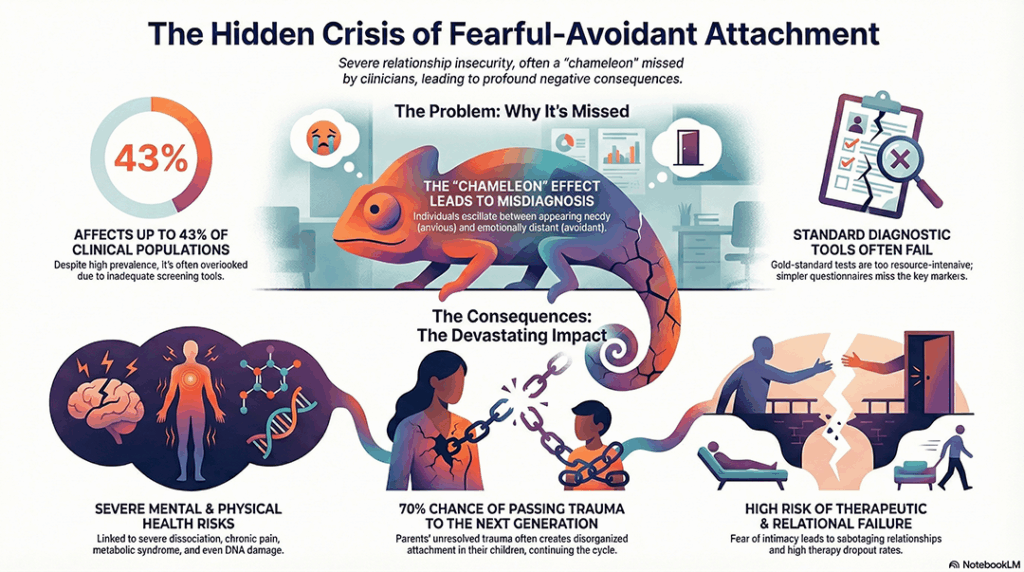
Fearful-avoidant attachment is not rare.
It’s just difficult to see.
People with this pattern are often described as confusing, contradictory, or “hot and cold.” They want closeness deeply, yet feel overwhelmed once it begins. They move toward connection and then pull away, not because they don’t care, but because caring activates fear.
From the outside, their behavior can look inconsistent. From the inside, it feels like being torn in two.
So why is this pattern so often missed?
Because it doesn’t behave consistently
Fearful-avoidant attachment doesn’t show up the same way all the time. It shifts depending on perceived safety.
When things feel distant, anxiety rises. When things feel close, fear rises. The nervous system never settles fully into either state.
That means fearful-avoidant people often get identified based on whichever “side” is showing at the moment. When they’re reaching out, they’re labeled anxious. When they pull back, they’re labeled avoidant. The underlying conflict goes unseen.
Because standard tools aren’t built for contradiction
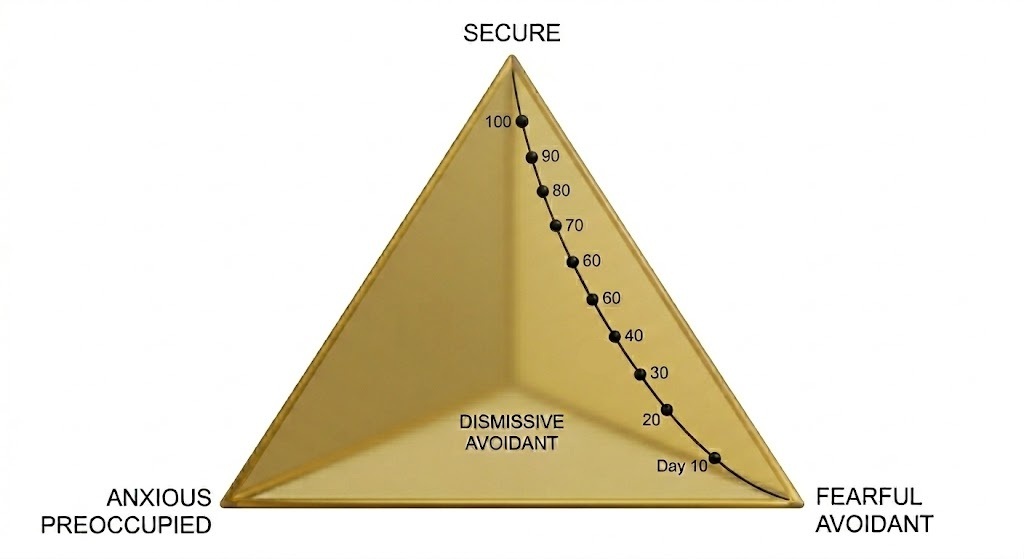
Most attachment assessments are designed to measure how much of something is present — how much anxiety, how much avoidance. They’re not designed to detect when opposing reactions occur together.
“As highlighted in Psychology Today (2024), disorganized attachment often ‘hides in plain sight’ because standard tools are looking for consistent strategies, but FA is defined by its lack of a consistent strategy—it is a state of biological ‘fight and flight’ occurring at the same time.”
But fearful-avoidant attachment is opposition.
It’s not too much closeness or too much distance. It’s the inability to find safety in either.
When assessments average answers, that opposition disappears. What remains looks moderate, situational, or secure-leaning — even when the person’s relationships are anything but stable.
Because fearful-avoidant behavior is often misunderstood
Fearful-avoidant people are frequently misread as dramatic, resistant, or self-sabotaging. Their withdrawal is interpreted as lack of motivation. Their approach is interpreted as neediness. Their shifts are interpreted as inconsistency.
What’s missed is that these behaviors are not choices. They’re protective responses to internal threat.
When closeness triggers fear, pulling away is not rejection — it’s regulation. When distance triggers panic, reaching out is not manipulation — it’s survival.
Without that lens, the pattern remains invisible.
Because it overlaps with other labels
Fearful-avoidant attachment is also commonly mistaken for personality traits or disorders. Emotional swings, fear of abandonment, difficulty trusting, sudden shutdowns — these features are often addressed without ever looking at attachment dynamics.
When attachment isn’t considered, treatment targets symptoms instead of roots. Progress stalls. Dropout increases. People are told they’re “difficult” when they’re actually dysregulated.
The cost of being missed
When fearful-avoidant attachment isn’t identified, people often receive guidance that doesn’t fit.
They’re encouraged to tolerate closeness when their system is overwhelmed. Or encouraged to detach when what they actually need is safety within connection. Over time, this mismatch deepens shame and confusion.
Many begin to believe they’re broken, unfixable, or incapable of healthy love.
They’re not.
Their nervous system learned rules that once kept them safe — and now need updating.
The impact doesn’t stop at emotions
Chronic relational stress doesn’t stay in the mind. When closeness consistently activates threat responses, the body pays a price. Many fearful-avoidant people experience chronic tension, fatigue, pain, or stress-related symptoms alongside relationship struggles.
The body carries what the relationship system can’t resolve.
Why accurate identification changes everything
When fearful-avoidant attachment is named correctly, people stop fighting themselves.
They understand why insight alone didn’t help. Why reassurance sometimes made things worse. Why independence never brought real relief.
They stop asking, “What’s wrong with me?” and start asking, “What does my nervous system need to feel safe?”
That shift changes how people approach therapy, relationships, pacing, and self-compassion.
The bottom line
Fearful-avoidant attachment has always been present. What’s changing now is our ability to recognize it. See how our proprietary Attachment Style Survey addresses the deficiencies of most surveys HERE!
By looking for internal conflict instead of surface behavior, we can finally see what was always there — and stop blaming people for adaptations that once helped them survive.
For many, being accurately identified isn’t just informative.
It’s the first moment they realize they were never broken — just misunderstood.
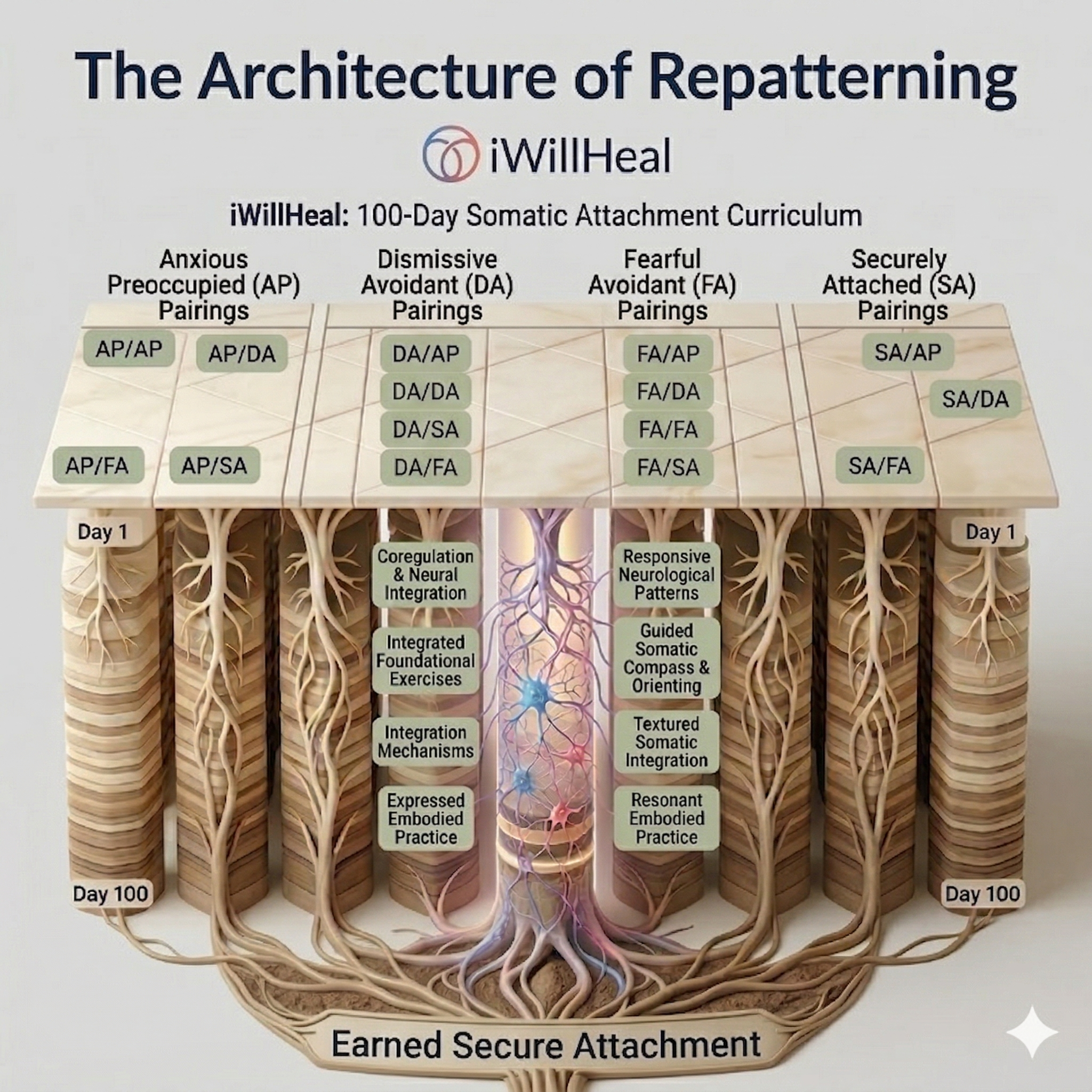
Links to our curriculum if YOU are Fearful Avoidant and your Ex/Partner is: