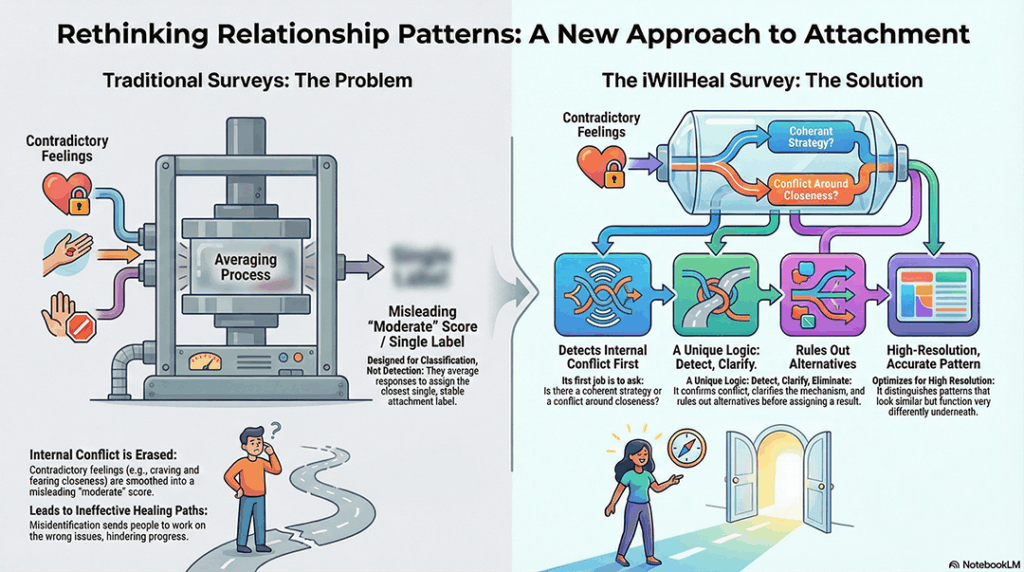
Why The iWillHeal Attachment Survey Is Different – And Why It Matters
Most attachment surveys weren’t built for real adult relationships. They were built to classify.
That distinction matters more than people realize, because classification assumes something that adult relationships rarely deliver: consistency. It assumes people show up the same way across partners, across time, and across emotional states. It assumes that if you measure enough traits and average them together, the truth will emerge.
For many people, that simply isn’t how attachment works.
The iWillHeal Attachment Survey was created because too many people were walking away from standard assessments feeling vaguely mislabeled. “Somewhat anxious.” “Avoidant-leaning.” “Secure, but…” None of those results explained why closeness felt both essential and terrifying. None explained why relationships followed the same push–pull arc over and over again. None explained why insight alone didn’t fix the problem.
So we stopped asking the industry’s favorite question — Which box does this person fit into? — and asked a more useful one:
What is this person’s nervous system doing in the presence of intimacy?
That shift is the foundation of our survey.
The problem with averaging behavior
Most attachment tools rely on averages. They ask how often you worry about abandonment, how comfortable you are with closeness, or how much you prefer independence. Then they average those answers and assign a label.
But averaging smooths out contradiction.
If someone desperately wants closeness and feels the urge to escape once it arrives, those forces cancel each other out statistically. The result looks moderate, when the lived experience is anything but. Internal conflict disappears into the math. Our survey is designed to catch conflict before it gets averaged away.
Detecting patterns before labeling them
Instead of waiting until the end to decide what someone “is,” the iWillHeal survey looks early for signals that matter most: tension, contradiction, and dysregulation around closeness.
Some people don’t struggle because they want too much or too little intimacy. They struggle because intimacy itself flips an internal switch. The same person can feel grounded one moment and flooded the next — not because they’re inconsistent, but because closeness activates competing survival responses. Traditional surveys weren’t built to see that. Ours is.
Clarifying what looks the same on the surface
Anxious behavior and fearful behavior can look identical from the outside. So can avoidant withdrawal and fear-driven shutdown. The difference isn’t what someone does — it’s why they do it.
Does distance calm the body, or make things worse?
Does withdrawal feel relieving, or does it come with regret and distress?
Does closeness create safety, or does it destabilize the system?
Those questions change the outcome. The iWillHeal survey doesn’t assume that surface behavior tells the whole story; it looks for the underlying mechanism driving it.
Eliminating before concluding
Another reason our survey feels different is that it doesn’t rush to label. It actively rules things out.
If a conflicted attachment pattern is confirmed, the survey doesn’t keep pretending the person is simply anxious or avoidant. If that conflict isn’t present, only then does it move on to evaluate other patterns. That process reduces false certainty and increases accuracy — not by adding complexity, but by being more precise about what’s actually happening.
Accounting for change, not just traits
Adult attachment isn’t frozen in childhood. People adapt. Relationships injure. Nervous systems learn new rules — sometimes protective, sometimes costly.
Most surveys don’t distinguish between a lifelong pattern and a stress-induced adaptation. The iWillHeal survey does. That’s why some people receive results that reflect activation or transition rather than a fixed label. Because sometimes the most honest answer isn’t “this is who you are,” but “this is how your system is responding right now.”
Why this matters
Misidentification isn’t neutral.
When people are told they’re anxious when their real issue is post-intimacy shutdown, they’re encouraged to push harder when they need safety. When people are told they’re avoidant when their system is overwhelmed by closeness, they’re encouraged to open up faster when slowing down would help.
The wrong label sends people down the wrong path. Accurate screening doesn’t heal on its own — but it points healing in the right direction.
The bottom line
The iWillHeal Attachment Survey isn’t different because it’s longer, harsher, or more complicated. It’s different because it listens for the things other surveys smooth over: internal conflict, nervous-system response, and secondary adaptation.
For many people, it’s the first time an attachment result actually matches their lived experience. And that’s where real healing starts.
Technical Reference & Clinical Foundations
The iWillHeal deterministic diagnostic protocol is grounded in the rigors of systems engineering and peer-reviewed relational science. For a deep dive into the engineering logic and structural audits used in our assessment, view our full documentation:
Internal Resource: Scientific Methodology & Diagnostic Protocol v4.2
Peer-Reviewed Citations:
Neurobiological Basis: Polyvagal Theory: Autonomic Nervous System & Attachment (Porges, S. W.)
Diagnostic Categorization: Taxometric Analysis of Attachment Patterns (Fraley, R. C., & Spieker, S. J.)
Physiological Indicators: Psychophysiological Predictors of Relational Anxiety and Avoidance (Diamond, L. M., & Fagundes, C. P.)